Roof Replacement Costs by Material Type in 2026: The Complete Homeowner's Pricing Guide
Roof Replacement Costs by Material Type in 2026: The Complete Homeowner's Pricing Guide
Published 2026-04-11 • Price-Quotes Research Lab Analysis
The Number That Should Make Every Homeowner Pause
Materials make up only 25% of your total roof replacement bill — but that 25% can cost you anywhere from $80 per square to over $3,000 per square depending on what you choose. That's not a typo. Price-Quotes Research Lab's analysis of pricing data across 20 major US cities confirms that material selection alone creates a potential 3,750% cost variance between the cheapest and most expensive roofing systems. Most homeowners don't discover this until they're already committed. By then, they've often locked themselves into a material that either needs replacing a decade sooner than expected or costs twice what a better option would have been. This guide fixes that. We're breaking down every major roofing material on the market in 2026 — real costs, real lifespans, real trade-offs — so you can make the call that fits your house, your budget, and your timeline.Understanding the Pricing Foundation: Squares, Labor, and What You're Actually Paying For
Before diving into material specifics, you need to understand how roofers price projects. They don't think in square feet — they think in squares. One square equals 100 square feet of roof area. A typical 2,000-square-foot house has a roof footprint around 2,200-2,400 square feet due to pitch and overhangs, which translates to roughly 22-24 squares. That distinction matters because it affects how you interpret every price in this article. When you see "$80-$250 per square," that's for materials only. According to HomeGuide's 2026 pricing guide, here's the full cost breakdown per square when installing a new roof:- Old roof removal: $100-$300 per square (if applicable)
- Roofing materials: $100-$250 per square (asphalt base range)
- Labor: $200-$350 per square
- Total installed cost: $400-$900 per square (asphalt)
2026 Roofing Material Cost Comparison Table
| Material Type | Cost per Square | Average Lifespan | Best For |
|---|---|---|---|
| Asphalt 3-Tab | $80-$130 | 15-20 years | Budget-conscious homeowners |
| Asphalt Architectural | $130-$250 | 25-30 years | Most residential applications |
| Metal Standing Seam | $400-$800 | 40-70 years | Long-term investment, severe weather |
| Metal Corrugated | $100-$300 | 30-50 years | Rural/agricultural, pole barns |
| Concrete Tile | $300-$600 | 50-100 years | Southwest, Mediterranean styles |
| Clay Tile | $600-$1,500 | 100+ years | Tuscan, Spanish Colonial architecture |
| Natural Slate | $800-$2,000+ | 75-150 years | Historic homes, luxury builds |
| Synthetic Slate | $400-$700 | 40-60 years | Slate appearance without structural load |
| Wood Shake | $200-$400 | 25-40 years | Craftsman, Tudor homes |
| Built-Up / BUR | $150-$400 | 15-30 years | Flat/low-slope roofs |
Asphalt Shingles: The 80% Market Share Workhorse
Asphalt dominates the American roofing market for a simple reason: it works, it's affordable, and almost every roofer knows how to install it. Industry data indicates asphalt shingles cover roughly 80% of residential re-roofing projects. But "asphalt" is a spectrum. 3-Tab Shingles are the entry-level option. They lay flat, come in one standard profile, and cost $80-$130 per square for materials. A 2,000-square-foot roof runs $1,600-$2,600 in materials alone. They're fine for what they are — a functional, budget-friendly surface — but they look flat, they crack faster than premium options, and wind damage becomes a real concern after year 10. If you're replacing a rental property roof or need to minimize upfront costs, 3-tab makes sense. For your primary residence, you're probably selling yourself short. Architectural (Dimensional) Shingles cost $130-$250 per square but deliver a dramatically different product. They have depth and shadow — they look like real slate or wood shake from the ground. They hold up better in wind (up to 130 mph versus 60-70 mph for 3-tab). They typically carry 30-year warranties versus 20-25 for 3-tab. For most homeowners, architectural shingles represent the sweet spot between cost and value. Price-Quotes Research Lab's 20-city pricing analysis shows architectural shingles account for the majority of residential installations in 2026, particularly in suburban neighborhoods where curb appeal matters for resale. Here's the catch: asphalt shingles are petroleum-based. When oil prices spike, shingle prices spike. Industry observers noted significant asphalt shingle price increases through 2024-2025 tied to crude oil volatility. The 2026 market has stabilized somewhat, but shingle prices remain elevated compared to pre-2022 levels. If you've been putting off a roof replacement expecting better prices, history suggests that waiting isn't a reliable strategy.Metal Roofing: The Long-Game Play
Metal roofing in 2026 is not your grandfather's corrugated barn tin. Today's metal roofs come in two primary profiles: standing seam (the premium architectural option with hidden fasteners) and exposed fastener systems (more affordable, still durable). Standing seam metal costs $400-$800 per square in materials alone. Installed, you're looking at $800-$1,800 per square depending on your region, roof complexity, and whether you need structural modifications. A 2,000-square-foot roof could cost $16,000-$36,000 fully installed. That's real money. But consider the math over 50 years. You'd replace asphalt two to three times — materials plus labor plus disposal — and still come out behind on a metal roof that looks better, performs better in hail and high winds, and reflects solar heat to reduce cooling costs by 10-25% according to energy studies cited by roofing contractors. Metal roofs also carry some of the best warranties in the industry. Kynar 500-coated steel — the premium finish — comes with 30-50 year finish warranties and often 30-year material warranties. Some manufacturers offer lifetime warranties on labor and materials for original homeowners. The upfront cost isn't the only barrier. Installation requires specialized skills. Not every roofer can do standing seam correctly. You need to verify certifications, check manufacturer training records, and ideally get three bids from contractors who specialize in metal rather than taking the lowest bid from a general roofer learning on your roof. Exposed fastener metal panels — often called corrugated metal — cost $100-$300 per square in materials. These are legitimate options for detached structures, agricultural buildings, and homes where the aesthetic fits (industrial modern, farmhouse). They're also finding more use in urban infill where housing density means adjacent rooflines matter for neighborhood aesthetics.Tile Roofing: Southwest Premium, National Reach
Concrete and clay tile roofs carry a premium image tied to specific architectural traditions, but they're increasingly found outside their traditional regions. Tile materials range from $300-$600 per square for concrete to $600-$1,500+ per square for clay. Fully installed, you're looking at $700-$2,000 per square depending on profile, region, and structural prep. The biggest hidden cost with tile: weight. Clay and concrete tiles are heavy — 600-1,500 pounds per square depending on the product. Many existing roof structures weren't designed for that load. Before committing to tile, you'll need a structural engineer to assess whether your framing can handle the weight, and possibly reinforcement work. That engineering and structural work can add $2,000-$8,000 to a project — sometimes more. The tradeoff is longevity. A properly installed clay tile roof can outlast the house it's on. Concrete tile offers 50-100 years of service with modern coatings that resist fading and efflorescence. If you're building custom or doing a full restoration, tile makes sense aesthetically and financially when you're planning to stay 30+ years. Synthetic alternatives — polymer-based tiles that mimic the look of slate or tile at a fraction of the weight — are gaining market share. They cost $300-$600 per square in materials and avoid the structural issues of natural tile. Quality varies significantly by manufacturer. Look for products with Class 4 impact ratings (the highest for hail resistance) and review manufacturer track records before committing.Slate: The Century Roof
Natural slate is the rarified end of residential roofing. It costs $800-$2,000+ per square in materials, requires specialized installers, and can exceed $3,000 per square fully installed in some regions. A 2,000-square-foot roof can easily cost $60,000-$80,000 with slate. But those numbers attract a specific buyer. Slate roofs last 75-150 years with minimal maintenance. They don't burn, they don't rot, they resist hail damage (though very hard hail can crack individual slates), and they have an architectural cachet that no other material matches. If you own a historic property, a high-end custom home, or simply want a roof that will outlast your great-grandchildren, slate remains the benchmark. The market is thin. There's a shortage of skilled slate installers in most regions. Getting three competitive bids can take months. Material sourcing matters — Vermont slate remains the gold standard but costs more; Chinese slate is more affordable but quality consistency varies. Expect to vet your materials as carefully as your contractor. Synthetic slate — typically made from recycled rubber and plastic compounds — offers the slate aesthetic at $400-$700 per square with none of the structural concerns. Modern composites are indistinguishable from natural slate from the ground. They carry 40-60 year warranties. For homeowners who want the look without the structural and financial burden, synthetic slate is the most underrated value in residential roofing.Regional Price Variations: Why Your Zip Code Matters
Roofing costs aren't uniform across the country. Price-Quotes Research Lab's 20-city pricing database reveals significant regional variance in 2026:- Sun Belt states (Texas, Arizona, Florida, Nevada): Labor costs run 10-20% below national averages due to year-round installation weather and lower union penetration. Material costs are similar, but overall project costs skew lower. Expect 5-15% savings versus coasts.
- West Coast (California, Pacific Northwest): Labor costs run 20-35% above national averages. Permit costs can add $500-$2,000 to projects. Wildfire building code requirements in California mean some materials require state fire-resistance certifications, adding cost and limiting options.
- Northeast (New England, Mid-Atlantic): Higher labor costs than national average, but competitive contractor markets keep prices from spiking as dramatically as West Coast. Snow load requirements influence structural specs and some material choices.
- Midwest: Most competitive pricing relative to material costs. Lower cost of living translates to more reasonable labor rates. Severe weather exposure means impact-resistant materials are often worth the upgrade.
- Mountain states (Colorado, Utah, Montana): Seasonal labor fluctuation creates pricing pressure. Summer months see elevated demand and pricing; shoulder seasons can offer 10-15% savings if your timeline is flexible.
- Houston, TX: $8,500-$11,500 installed
- Phoenix, AZ: $9,000-$12,000 installed
- Denver, CO: $10,000-$13,500 installed
- Los Angeles, CA: $13,000-$18,000 installed
- Seattle, WA: $11,500-$15,500 installed
- Boston, MA: $12,000-$16,000 installed
The Material Cost-Size Equation
Using HomeGuide's 2026 pricing data, here's how material costs scale by roof size for the most common material choices:| Roof Size (SF) | Squares | Asphalt Materials | Metal Materials | Tile Materials |
|---|---|---|---|---|
| 1,000 | 10 | $800-$2,500 | $1,000-$8,000 | $3,000-$15,000 |
| 1,500 | 15 | $1,200-$3,750 | $1,500-$12,000 | $4,500-$22,500 |
| 2,000 | 20 | $1,600-$5,000 | $2,000-$16,000 | $6,000-$30,000 |
| 2,500 | 25 | $2,000-$6,250 | $2,500-$20,000 | $7,500-$37,500 |
| 3,000 | 30 | $2,400-$7,500 | $3,000-$24,000 | $9,000-$45,000 |
| 3,500 | 35 | $2,800-$8,750 | $3,500-$28,000 | $10,500-$52,500 |
Hidden Costs That Surprise Homeowners
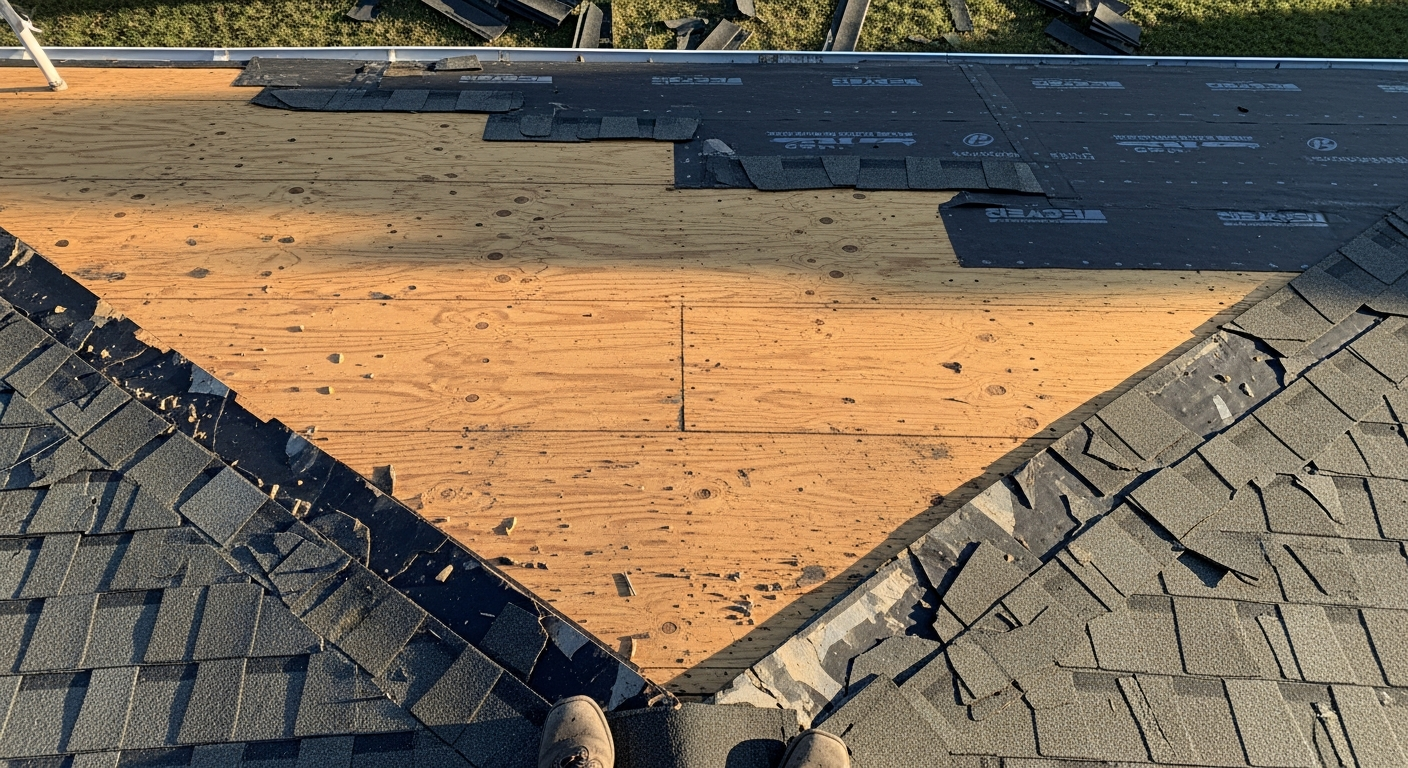
Most homeowners budget for shingles or tiles and get blindsided by what the roofer finds once work begins. These are the costs that don't appear in material price lists: Roof Decking Replacement: Plywood sheathing beneath your shingles deteriorates. When roofers tear off the old roof, they often discover damaged or rotted decking that needs replacement. Plywood runs $50-$100 per 4x8 sheet installed. A full deck replacement can add $2,000-$5,000 to a project depending on scope. Structural Modifications for Tile or Slate: As mentioned, tile and slate are heavy. If your roof structure needs reinforcement to handle the load, expect $3,000-$15,000 in structural work before the first tile is laid. Asbestos Abatement: Homes built before 1980 may have asbestos in existing roofing materials. Abatement by licensed contractors costs $1,500-$5,000+ depending on roof size and asbestos type. This is non-negotiable if present — you cannot just cover it. Permit and Inspection Fees: HomeAdvisor's 2026 contractor survey found permit costs range from $150-$2,000 depending on municipality and project scope. Some jurisdictions require engineering inspections for re-roofing. Budget $500-$1,500 for permits in most markets. Disposal Fees: Old roofing material goes somewhere. Dumpsters and disposal fees add $300-$1,500 to projects depending on material type and local landfill rates. Some municipalities charge extra for contaminated debris. Gutter Replacement: If your gutters are marginal, doing them during a roof replacement saves money versus separate projects. But it adds $1,000-$4,000 to the upfront bill.The Repair vs. Replace Decision in 2026
When roofing contractors assess a property, they typically recommend replacement over repair when:- The roof is within 5-7 years of its expected lifespan
- More than 25-30% of shingles show visible damage
- There are active leaks in multiple locations
- The deck shows widespread moisture damage
- Building code requires bringing the roof up to current standards
Warranties: Reading the Fine Print
Every major shingle manufacturer offers warranties, and the marketing sounds comprehensive. Read carefully. Material warranties cover manufacturing defects. They typically run 25-50 years for architectural shingles. But they're prorated — after year 10, coverage decreases annually. A 30-year prorated warranty might pay 50% of replacement costs in year 20. Workmanship warranties come from the contractor, not the manufacturer. These typically run 2-10 years. A roofer who offers only a 2-year workmanship warranty is signaling something about their confidence in their work. Enhanced warranties — the 25-year, 30-year, or lifetime warranties with full replacement — usually require:- Using the manufacturer's entire system (specific underlayment, ridge vents, flashing)
- Installation by a certified contractor
- Registration within 30-60 days of installation
- Occasional professional inspections
Financing Your Roof in 2026
A full roof replacement on a mid-sized home can run $12,000-$25,000 for asphalt, $25,000-$50,000 for metal. That's not a discretionary purchase for most households. Options available in 2026: Contractor financing: Many large roofing companies partner with lenders to offer 12-24 month deferred interest or lowAPR financing. Terms vary widely. Read the contract carefully — deferred interest that isn't paid off in full triggers back-interest charges from day one. Home Equity Lines of Credit (HELOCs): If you have equity, a HELOC typically offers lower rates than contractor financing or personal loans. Draw only what you need and pay it down aggressively. Manufacturer programs: Some roofing manufacturers offer financing specifically tied to their products, sometimes with better terms than general contractor financing. Property Assessed Clean Energy (PACE): In some states, PACE financing allows homeowners to finance energy-efficient roofing improvements through property taxes. Requirements and availability vary by state and municipality. Insurance claims: If your roof was damaged by a covered event (hail, wind, falling tree), your homeowner's insurance may cover replacement or substantial reimbursement. Document damage thoroughly, get multiple contractor assessments, and don't rely solely on the insurance adjuster's initial estimate — it's often low.What 2026's Market Means for Your Decision
Three trends are reshaping the roofing market this year: Labor shortages are real. The roofing trades lost significant workforce during the 2020-2022 period. Experienced installers remain in short supply. This means higher labor costs, longer lead times for project starts, and some quality variance as companies pull from a thinner pool of qualified workers. Material costs have stabilized but remain elevated. Post-2022 oil price volatility normalized somewhat, but asphalt shingle prices haven't retreated to pre-pandemic levels. Steel prices — critical for metal roofing — remain influenced by global trade dynamics. Expect 2-5% annual price increases rather than the double-digit jumps of 2021-2023. Impact resistance matters more. Insurers in many states are raising premiums or dropping coverage based on roof age and material. A Class 4 impact-rated shingle (the highest rating for hail resistance) can meaningfully reduce insurance costs in affected regions. This impacts the true cost-of-ownership calculation for different materials.The Bottom Line: Making Your Call
For most homeowners, architectural asphalt shingles at $130-$250 per square represent the best balance of upfront cost, aesthetics, longevity, and installation availability. A 2,000-square-foot roof fully installed runs roughly $10,000-$15,000 in most regions. That's real money but achievable for families with reasonable savings or home equity. For long-term residents planning to stay 20+ years, metal standing seam deserves serious consideration. Yes, the upfront cost is 2-3x asphalt. But over 50 years, when you factor in avoided replacement cycles and lower maintenance, the economics often favor metal — plus you get better energy efficiency, superior weather resistance, and a 40-70 year lifespan with minimal intervention. For historic properties or homeowners prioritizing aesthetics and willing to invest, slate or premium tile delivers unmatched character and generational durability. The cost is significant, but so is the result.The one screenshot you need: Materials make up only 25% of your roof replacement cost — but choosing asphalt vs. metal vs. slate can swing your total project from $12,000 to $60,000 on the same-size house. The material decision is where most of the money lives.
Your Next Move
Don't rely on a single contractor's estimate. Get three bids from certified installers for your specific roof. Use this article's pricing ranges as benchmarks — if a bid comes in 30% below the low end of the range, something's wrong. Either the contractor is cutting corners, using inferior materials, or missing scope. Before you sign anything, ask for proof of licensing and insurance, check manufacturer certifications for whatever product they're proposing, and verify warranty registration procedures so your coverage actually takes effect. Price-Quotes Research Lab aggregates pricing data from contractor networks across 20 major US cities. If you want to cross-reference local quotes against real market ranges, start there. The research is free. The knowledge could save you thousands.Source: homeguide.com
Key Questions
What is the average cost of a new roof in 2026?
The national average for a full roof replacement in 2026 is $9,192 according to Consumer Affairs data cited by Apex Roofing. Most homeowners pay between $5,800 and $12,800 depending on roof size, material, and region. Architectural asphalt shingles typically run $10,000-$15,000 fully installed on a 2,000-square-foot home.
How much do roofing materials cost per square in 2026?
Material costs per square (100 SF) in 2026: asphalt 3-tab $80-$130, architectural shingles $130-$250, corrugated metal $100-$300, standing seam metal $400-$800, concrete tile $300-$600, clay tile $600-$1,500, natural slate $800-$2,000+. Add $400-$750 per square for professional installation on asphalt, $600-$1,000+ for metal and tile.
Is it worth replacing shingles with metal roofing?
Metal roofing costs 2-3x more upfront than asphalt but lasts 40-70 years versus 20-30 years. Over a 50-year period, metal often costs less than replacing asphalt twice. Metal also offers 10-25% energy savings, superior wind resistance, and better resale value in many markets. The break-even depends on how long you plan to stay and your local insurance premium impacts.
How do I know if I should repair or replace my roof?
Replace when: the roof is within 5-7 years of its expected lifespan, more than 25-30% shows visible damage, you have leaks in multiple locations, or code requires upgrades. Repair when: the roof is relatively new, damage is localized (under 10-15% of surface), and the rest of the roof is in good condition. The most common homeowner regret is choosing repair when replacement was the better long-term call.
What are the regional price differences for roof replacement?
Roofing costs vary significantly by region in 2026. Sun Belt states (Texas, Arizona, Florida) run 10-20% below national averages. West Coast costs 20-35% above average due to labor and permits. Northeast and Mountain states run moderately above average. Midwest offers the most competitive pricing relative to material costs.
What hidden costs surprise homeowners during roof replacement?
Hidden costs beyond materials include: roof deck replacement ($2,000-$5,000 if needed), structural modifications for heavy materials like tile ($3,000-$15,000), asbestos abatement in homes built before 1980 ($1,500-$5,000), permit fees ($150-$2,000), disposal fees ($300-$1,500), and potential gutter replacement ($1,000-$4,000).